Genre : Hack & Slash / RPG
Graphics : 10/10
Storyline : 7/10
After complaining for so long, I finally got "my complains through." The game finally improved on the RPG element. Now you can customize your "musou", elemental type of the weapon, and also like other RPG games, making the weapon itself. I got bored from the previous games easily, since they were basically, hack, slash, pick up some weapon, maybe a mount or two, and then rinse, repeat. My second "complain", which actually made me LOVE the game was the Co-Operative function. ALL, and I really mean ALL, your mission can be done with your frieds and buddies. Even if it's single player missions, or storyline missions, all can be done through WLAN. The graphics are awesome also. Personally I feel that the graphics and colour scheme is on par, or maybe slightly better than Final Fantasy : Dissidia. Storyline seems reasonable. I'm not a big fan of theirs, and I don't usually play a game for it's storyline. I just use the storyline to know where I should be going next. Thus, this game is a +1, since the directions, or choices that the player have a very few and that the game direction is straightforward. No need to go look around where to go, since the objectives are said before hand and is usually shown in the map itself. Serves very well as a travelling companion where you want to play short games over long periods of time. That which enhances the game experience is the challenge provided by the AI itself. At higher levels, if your character is not buffed enough, random hacking and slashing might just backfire on you. Instead of you killing the enemy with you attacks, the enemies will be attacking you, since you left yourself open. This game "allows cheating", in a sense that, with proper combination of equipment and abilities, players can attain god-like status, a.k.a. GodMode.
Wednesday, May 20, 2009

Wednesday, May 6, 2009
#1 Fable - Xbox
Genre : RPG
Graphics : 8/10
Storyline : 7/10
Overall, Fable is one of the few great RPGs around. I first heard it on one of the TV's game review shows. The game play was quite new to me, as it featured role-playing, without basic level. The only experience would be used for skills, or 'stats' of the characters. I find it interesting that the experience is gained if that 'category' is used to kill a monster, or in case of 'agile', you can even gain experience from stealing. YES! First game I've played which allows players to STEAL FROM NPC, shopkeepers, who place their items on their counters. Actually other than that, you can pick-lock doors and sneak into houses, to steal stuff. OR, if you're just bored, you can just travel to some town and KILL EVERYONE OFF!!! You gain their properties , their house or shop. Just make sure you're strong enough to kill off all the guards. Other than that, it seems that the game itself is good for people who want to relief stress and those who don't want to follow any storyline or and linear type of game play.
The New Usage
Recycled from COMG. It shall now be use for game reviews for Principle Of Game Design!
The life of gamers...
The life of gamers...
Tuesday, November 11, 2008
My First 3D... Or so...
Many things missing... Lots of missing updates, 2 weeks worth... Will update soon!!!
Here's my work for practical 4... It look FAR from what is needed... BUT THE MAIN POINT IS THERE... I just need to mess around with the z-axis co-ordinates to get it right...
I call the first one...

"Teh 4-Way PAIP!
And one more from 50, 50, 50 camera view...

Failed...
Here's my work for practical 4... It look FAR from what is needed... BUT THE MAIN POINT IS THERE... I just need to mess around with the z-axis co-ordinates to get it right...
I call the first one...

"Teh 4-Way PAIP!
And one more from 50, 50, 50 camera view...

Failed...
Friday, October 24, 2008
My First Pixels...
Before I begin, I'd like to attempt to solve the lecture questions.
Quote question - "How many textures can they use if they are limited to 256 x 256, with a 24 bits palette of 8 bits colour depth?"
- still trying to figure out -
32MB/(256*256*24) = 268435456 bytes /1572864
= 170.6666667
hmm, different answer...
Side note: This week's lecture, 2, is mainly about pixels, resolution, colours, and rendering. New terms such as buffer, double buffer, as well as old terms like bits, bytes, megabytes. Now I know how the flickering problem was 'solved'.
Now, back to the task at hand. This post will be dedicated for Week 2's Practical.
Questions & Answers(hopefully)
Qn 1: Define a Callback function
Ans 1: A callback function is a function which is executable code which is passed to another function as an argument, eg, function_Name(callback_Function);
Qn 2: When exactly is myDisplay() called? How do you get to your findings?
Ans 2: It is called, JUST after the program draws the screen. Upon debugging, if we keep track of the function, it will show us precisely when a function is carried out.
Qn 3: List the process to access the VRAM.
Ans 3: Memory pointer to the VRAM is obtained. A double buffer memory is obtained. It is then cleared before being modified. After which, it is copied to the VRAM before being cleared once again.
Question 4: What colour format are we using here i.e. 8 bits, 16 bits, 24 bits or 32 bits?
A pixel takes up to 1 byte of information, as the values range from 0 to 255. Thus we are using 8 bits colour format since 8 bits = 1 byte.
Question 5: How much memory have we allocated?
Ans 5: 800*600*1 = 480 000 bytes
About ~ 468.8 kilobytes
Question 6: Describe what has glDrawPixel() done.
Ans 6: glDrawPixel() has just sent data for the system to draw the plotted pixels on the screen/window which was previously created.
Practical Results
Here are some of the screenshots of the pixels which I was able to plot, from modifying the code.
"Vertical Lights"

What I 'created' by accident. I actually wanted to code a 'Melt Up', but I got this instead. Still it's cool. And no, it's not random vertical lines being drawn to the screen. It starts out full screen. At
certain intervals, the lines disappear, making it seem like a laser show.
"Batik Design"

As the name suggest, it looks like part of a "Batik" design.
"Tiled Floors"
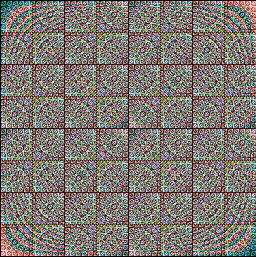
Looking at this reminds me of special tile designs, usually seen in documentaries from some magnificent building.
*Tip for readers: If you want to get these odd colurs, try inserting varying values for the colours.
All in all, it was a good practice, especially since this is out first time learning and using OpengGL.
Quote question - "How many textures can they use if they are limited to 256 x 256, with a 24 bits palette of 8 bits colour depth?"
- still trying to figure out -
32MB/(256*256*24) = 268435456 bytes /1572864
= 170.6666667
hmm, different answer...
Side note: This week's lecture, 2, is mainly about pixels, resolution, colours, and rendering. New terms such as buffer, double buffer, as well as old terms like bits, bytes, megabytes. Now I know how the flickering problem was 'solved'.
Now, back to the task at hand. This post will be dedicated for Week 2's Practical.
Questions & Answers(hopefully)
Qn 1: Define a Callback function
Ans 1: A callback function is a function which is executable code which is passed to another function as an argument, eg, function_Name(callback_Function);
Qn 2: When exactly is myDisplay() called? How do you get to your findings?
Ans 2: It is called, JUST after the program draws the screen. Upon debugging, if we keep track of the function, it will show us precisely when a function is carried out.
Qn 3: List the process to access the VRAM.
Ans 3: Memory pointer to the VRAM is obtained. A double buffer memory is obtained. It is then cleared before being modified. After which, it is copied to the VRAM before being cleared once again.
Question 4: What colour format are we using here i.e. 8 bits, 16 bits, 24 bits or 32 bits?
A pixel takes up to 1 byte of information, as the values range from 0 to 255. Thus we are using 8 bits colour format since 8 bits = 1 byte.
Question 5: How much memory have we allocated?
Ans 5: 800*600*1 = 480 000 bytes
About ~ 468.8 kilobytes
Question 6: Describe what has glDrawPixel() done.
Ans 6: glDrawPixel() has just sent data for the system to draw the plotted pixels on the screen/window which was previously created.
Practical Results
Here are some of the screenshots of the pixels which I was able to plot, from modifying the code.
"Vertical Lights"

What I 'created' by accident. I actually wanted to code a 'Melt Up', but I got this instead. Still it's cool. And no, it's not random vertical lines being drawn to the screen. It starts out full screen. At
certain intervals, the lines disappear, making it seem like a laser show.
"Batik Design"

As the name suggest, it looks like part of a "Batik" design.
"Tiled Floors"

Looking at this reminds me of special tile designs, usually seen in documentaries from some magnificent building.
*Tip for readers: If you want to get these odd colurs, try inserting varying values for the colours.
All in all, it was a good practice, especially since this is out first time learning and using OpengGL.
Wednesday, October 15, 2008
Game Review

Title of the Game: N+
Platform of Game: PSP, DS, Xbox360
Genre of Game: 2D, Action, Platformer
Developer: Atari
Product Model Year: 2008
Game Requirements: None specific, only the console and handheld device.
Description of the game – You get to play as a ninja, with high agility as well as fragility. Game level consists of obstacles, which more often than not requires precision and timing to nail it.
Game Play - Simple controls on the PSP system, directional pad + to move your ninja & (x) button to do a jump. The longer you hold the higher your jump. Too high a jump without proper landing, leads to instant death. Good for handheld consoles since it’s more of the pick up and play type. No storyline.

Graphics – Simple but effective. The ninja is ‘stick-ed’, as in stickman drawings. But that is a good thing in this game, where one slight move could spell disaster. No 3D, no special effects, just 2D explosion upon contact with explosives.
Sound – Intro music is nice and catchy. In-game music is hardly in any way, distracting to players. Sound effects are appropriate, especially upon deaths from different causes. No repeated SE or weird/unmatched SE.
Conclusion – Good game to get if you plan on ‘travelling’ a lot, since auto-save points are 4 stages apart. The obstacles in each stage, forces you to develop a plan so as to be able to successfully complete each stage. It trains your reflex and reaction times as well as time management. Time is 2nd or 3rd on the ‘important to look out for’ list. I give it 4/5 overall.
Resources:
Subscribe to:
Posts (Atom)